How Swiss–Chinese trade could benefit Russian buyers
Switzerland left 14 companies registered in mainland China or Hong Kong off its export control list. TriTrace Investigations examined their links to Russian supply chains.
On 4 November 2026, Switzerland announced it would adopt the EU’s 21st sanctions package against Russia. However, Bern left out 14 companies that the EU had placed under enhanced export controls in July 2026 due to their links to Russia’s military-industrial complex or involvement in sanctions circumvention.
TriTrace Investigations found that all 14 were registered in mainland China or Hong Kong. Thirteen appear in the Russian customs declarations we reviewed. Some of these shipments illustrate contradictions in Switzerland’s sanctions policy.
Swiss spare parts in Russia
Russia’s Unimatic group set up Dalian Unimatic in China in 2022. That year, the group and its partners also acquired Swiss machine tool maker Bystronic’s Russian subsidiary and renamed it Altegrity.
In 2024–2025, Dalian Unimatic supplied Altegrity with around US$45,000 worth of Swiss Bystronic spare parts. In November, Switzerland listed Altegrity and left its Chinese supplier off the list.
Electronics for Russia’s defence industry
In September 2023, Hong Kong’s Xiefeng shipped around US$1.17 million worth of Altera chips to Russia’s VNIIR-Progress. The Russian company’s CEO said in 2024 that its products are used in drones, precision-guided munitions and other military equipment. Switzerland listed VNIIR-Progress in March 2024. It did not add Xiefeng to the list.
Switzerland’s selective approach
In 2025, Bern declined to adopt EU restrictions on two Chinese banks. Swiss MP Fabian Molina suggested the government wanted to avoid straining ties with China during trade talks. The Swiss authorities rejected his explanation, citing no evidence of business ties between the banks and Swiss institutions. In April 2026, the EU delisted both banks.
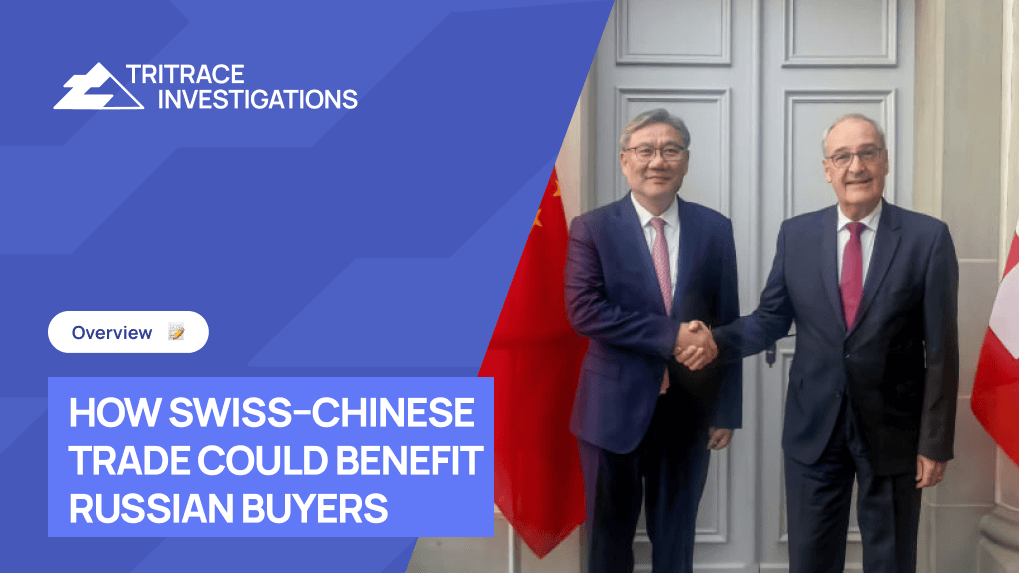
For the November decision, Bern cited foreign policy and legal considerations and said existing measures could prevent circumvention. Five days before the announcement, Swiss President Guy Parmelin met Chinese President Xi Jinping. The two countries signed an updated free trade agreement intended to improve access to China for Swiss goods and investment.
With the updated trade agreement, sanctioned Russian companies could try to source sensitive goods through established Chinese suppliers that Bern left off its export control list.
Photo: Swiss President Guy Parmelin and Chinese Commerce Minister Wang Wentao after talks on updating the free trade agreement. Bern, 20 August 2026. Credit: Ministry of Commerce of China.