Wayback Machine in Court: Using Web Archives in Litigation
How can website snapshots be properly verified for use in court, and what factors should be considered when choosing a web archiving service?
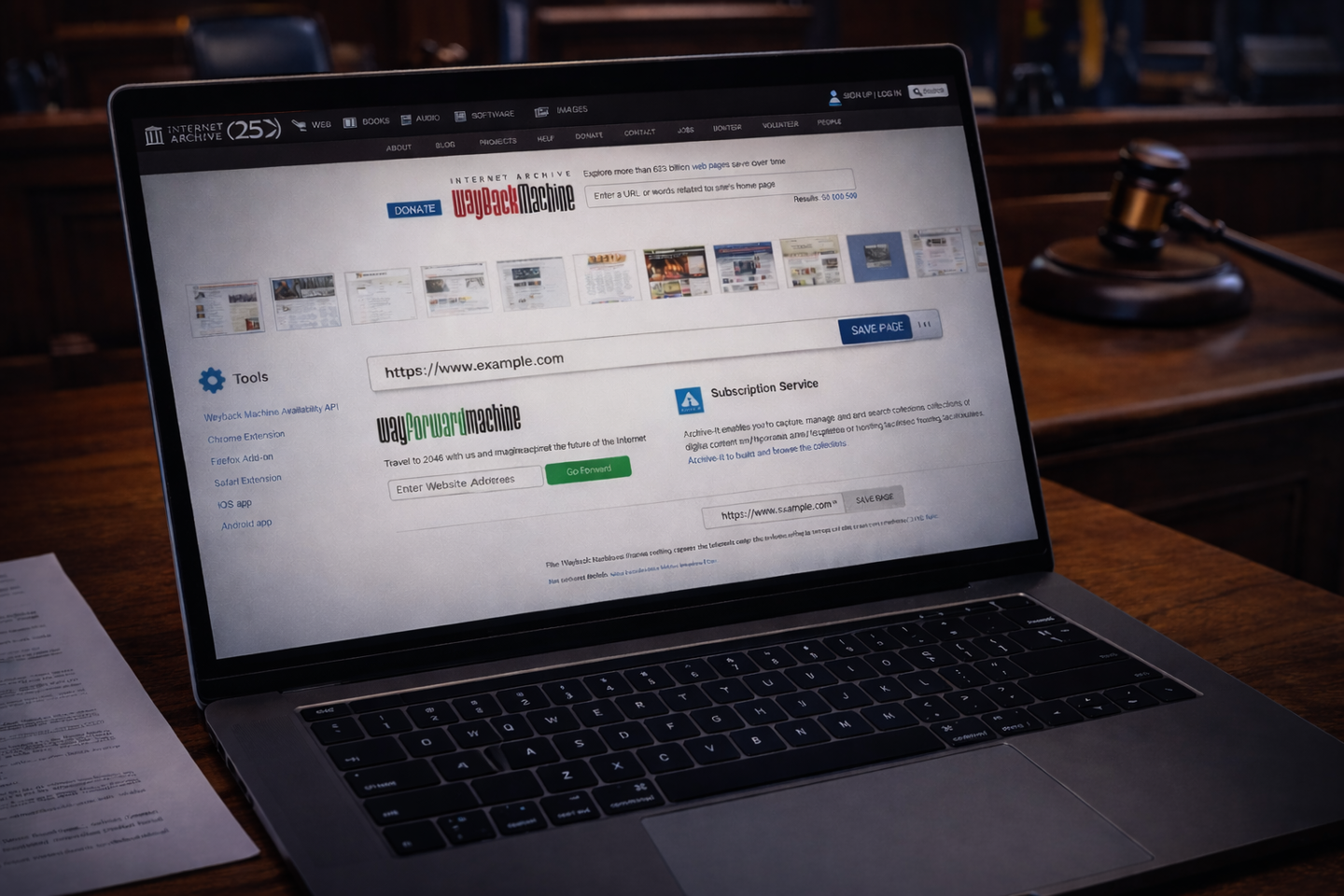
The primary web archive of the internet, The Internet Archive’s Wayback Machine, is a project of a U.S.-based nonprofit digital library that preserves books, audio, video, and software. Since 1996, the Wayback Machine has collected over one trillion snapshots of web pages, with some pages archived dozens of times per day.
Snapshots from the Wayback Machine can be submitted as evidence in court. TriTrace Investigations conducted its own review of how different web archiving tools are used in litigation and compliance audit contexts. Below, we outline how to verify an archived copy of a website for use in legal proceedings, including in the context of sanctions letigation.
Practical Use of Wayback Machine
Links to Wayback Machine snapshots have been reviewed by courts in the United States, the European Union, and Russia. In the cases we analyzed, Wayback Machine snapshots were never used as the sole (self-sufficient) piece of evidence.
To use Wayback Machine effectively, screenshots of a website are best supported by a notarized inspection report. Legal scrutiny typically focuses on the authentication of archived web page snapshots.
Upon request, The Internet Archive can authenticate a snapshot. The organization provides supporting documentation for a fee: $250 per request plus $20 per URL ($30 if the link points to a downloadable file). A notarized affidavit from the Internet Archive costs an additional $100.
It is important to note that Wayback Machine and similar web archiving tools capture web pages in a static format only. For example, video content cannot be preserved through this service.
Wayback Machine also has limitations when dealing with dynamically loaded website elements, which may affect its evidentiary value in court. One example is a dispute between JMS Sports and the European Union Intellectual Property Office over the design of a hair tie. JMS Sports challenged the use of a Wayback Machine snapshot on the grounds that the image central to the dispute had not been archived but was instead loaded from the live version of the website. Nevertheless, the the court held that the snapshot was admissible and relevant evidence.
Alternative Services
archive.today is most widely used archiving service used by fact-checkers, according to survey by Vera AI. It performs better with dynamic content, however, its operators are anonymous and assistance in court depends on their discretion. “While the snapshots were indeed used in civil courts <..> you are dependent on my whim whether I choose to assist you or not, as I am under no obligation to do so”, – said archive[.]todaу administrator in a blogpost.
In early 2026, archive.today was found to have edited snapshots related to a dispute with blogger Gyrovague. This was later acknowledged by archive.today administrator. The incident represents a significant precedent that undermines trust in the reliability of archive.today snapshots.
While Wayback Machine removes data upon request from copyright holders and website owners, archive.today has a reputation as a more “piracy-tolerant” tool and is generally less responsive to takedown requests. Both platforms, however, comply with requests from law enforcement agencies to remove archived web pages.
Another tool, Perma.cc, according to the same fact-checking survey, ranks third in popularity (after archive[.]today and Wayback Machine) among web archiving tools. It was developed by the Harvard Library Innovation Lab at the Harvard Law School Library. The service is paid, although courts and academic researchers may obtain free access.
The project team has also developed Scoop, a browser extension for archiving web pages with built-in support for cryptographic signing (WACZ Signing and Verification).


